Therapy & Counseling
Depression Treatment in Hermosa Beach & the South Bay
Depression is more than sadness: it is a persistent low or flat mood that drains energy, interest, and hope, often for weeks or longer. Depression treatment is work with a licensed clinician to understand what is keeping you stuck and to rebuild momentum, connection, and meaning, using approaches with strong research behind them. At Bodhi Wellness Collective, depression is one of the most common reasons people reach out, and therapy and psychiatry work together under one roof.

- Licensed clinicians
- Hermosa Beach + virtual
- Free 15-minute consultation
- Accepting new clients

We see clients in person at our office on Pacific Coast Highway in Hermosa Beach, a short drive from Redondo Beach, Manhattan Beach, Torrance, and El Segundo, and by secure video anywhere in California.
Depression is common, and many people never get help for it. In 2021, 8.3% of U.S. adults and 20.1% of adolescents ages 12 to 17 had a major depressive episode. Among them, 61.0% of adults and only 40.6% of adolescents received treatment (National Institute of Mental Health).
Source: National Institute of Mental Health.
Signs it may be time to talk to someone
- Low, flat, or empty mood most days, for two weeks or more
- Losing interest in things you used to enjoy, including people
- Sleeping much more or much less than usual
- Fatigue, heaviness, or everything taking more effort than it should
- Harsh self-criticism, guilt, or feeling like a burden
- Irritability, a short fuse, or drinking more to take the edge off
- Trouble concentrating, or work and relationships starting to slip
Physical causes such as thyroid problems can mimic depression, so it is worth seeing a physician too, especially if this is new. If you are having thoughts of ending your life, call or text 988 now.
Everyday sadness vs. depression
| Ordinary sadness | Depression | |
|---|---|---|
| Duration | Lifts within days | Persists most days for two weeks or more |
| Interest | Still enjoy things, mostly | Loss of interest or pleasure |
| Energy | Largely intact | Fatigue, heaviness, hard to start |
| Sleep and appetite | Mostly unchanged | Noticeably more or less than usual |
| Self-view | Stable | Worthlessness, guilt, hopelessness |
Forms of depression we treat
- Major depression: Low mood or loss of interest most days for two weeks or more
- Persistent low mood (high-functioning depression): Years of feeling flat while still getting everything done
- Seasonal depression: A pattern that returns in fall and winter
- Postpartum depression: Depression during pregnancy or after a baby arrives
- Depression after a loss: Grief that has not eased with time
- Depression in men: Often shows up as irritability, overwork, or drinking
- Situational depression: Triggered by a breakup, job loss, move, or other change
Depression in teens
Teen depression often does not look like sadness. It can look like irritability, pulling away from family, sleeping all day, slipping grades, or quitting things they used to love. In a 2023 national survey, about 40% of U.S. high school students reported feeling so sad or hopeless almost every day for two weeks or more that they stopped doing some usual activities (CDC Youth Risk Behavior Survey).
Source: Centers for Disease Control and Prevention, 2023 Youth Risk Behavior Survey.
We work with teens and families from Manhattan Beach, Hermosa, Redondo, and Palos Verdes through our teen therapy, with parents involved in a way that protects the teen's trust. If you are wondering what a therapist will share with you, our guide to teen therapy confidentiality covers it.
How depression treatment works here
Our clinicians draw on the approaches with the strongest evidence and choose among them based on what is driving your depression. Most people get a blend.
| Approach | What it works on | Often a good fit when |
|---|---|---|
| Cognitive behavioral therapy (CBT) | Hopeless, self-critical thinking and the habits that keep it going | Your mind keeps telling you nothing will change |
| Behavioral activation | Withdrawal, by rebuilding activity and connection in small, planned steps | Everything feels like too much effort to start |
| EMDR or Somatic Experiencing | Depression tied to past experiences or trauma | Low mood traces back to something that happened to you |
| Couples or family therapy | The relationship patterns around the depression | Depression is straining a marriage or family, or being made worse by it |
| Psychiatry and medication | Symptoms that are severe, long-lasting, or not improving | Sleep, energy, or functioning are significantly affected |
What the research says
Effective depression treatment does not have to be complicated. In a 2016 randomized trial of 440 adults with depression, behavioral activation, a focused approach built around re-engaging with activity and people, was as effective as CBT at one year (Richards et al., The Lancet, 2016). And when medication is part of the plan, adding therapy matters: a 2014 meta-analysis of 52 studies found that therapy plus medication worked better than medication alone for depression and anxiety disorders (Cuijpers et al., World Psychiatry, 2014). Results vary from person to person, and the fit with your therapist matters too.
Sources: Richards et al. (2016); Cuijpers et al. (2014).
Because therapy and psychiatry are coordinated within the same practice, your therapist and your prescriber stay in step. Our psychiatrist, Dr. Alexander Sones, MD, also provides psychotherapy alongside medication management. Our guide to therapy vs. psychiatry explains when each makes sense.
What Jack Foley, LMFT, tells people at the start of depression work:
"Depression tells you nothing will help and there's no point trying. The work often starts with small, doable steps, and momentum tends to build faster than people expect."
What to expect
- A short first conversation. You tell us what has been going on, and we match you with a clinician whose approach fits. There is no cost for this call.
- Assessment. The first session or two map out your depression: when it started, what makes it better or worse, and what you want to be different.
- A plan you agree on. Your therapist explains the approach, what practice between sessions looks like, and whether a psychiatric evaluation makes sense.
- Small steps, built on. Most people start weekly and space sessions out as things improve.
When a different first step makes sense
If drinking or drug use has become the main way you cope, our addiction treatment team can work alongside depression therapy. If low periods alternate with stretches of unusually high energy or little need for sleep, our bipolar disorder care starts with a careful evaluation. If someone you love is the one struggling, our guide to supporting a partner with depression may help.
If you have been carrying this for a while, reach out. You do not need to know what kind of help you need. A short conversation is enough to start, and we will help you figure out the rest.
If you are having thoughts of harming yourself, you do not have to wait. Call or text 988 to reach the Suicide and Crisis Lifeline, any time.
Where we are
One South Bay office.
All of California.
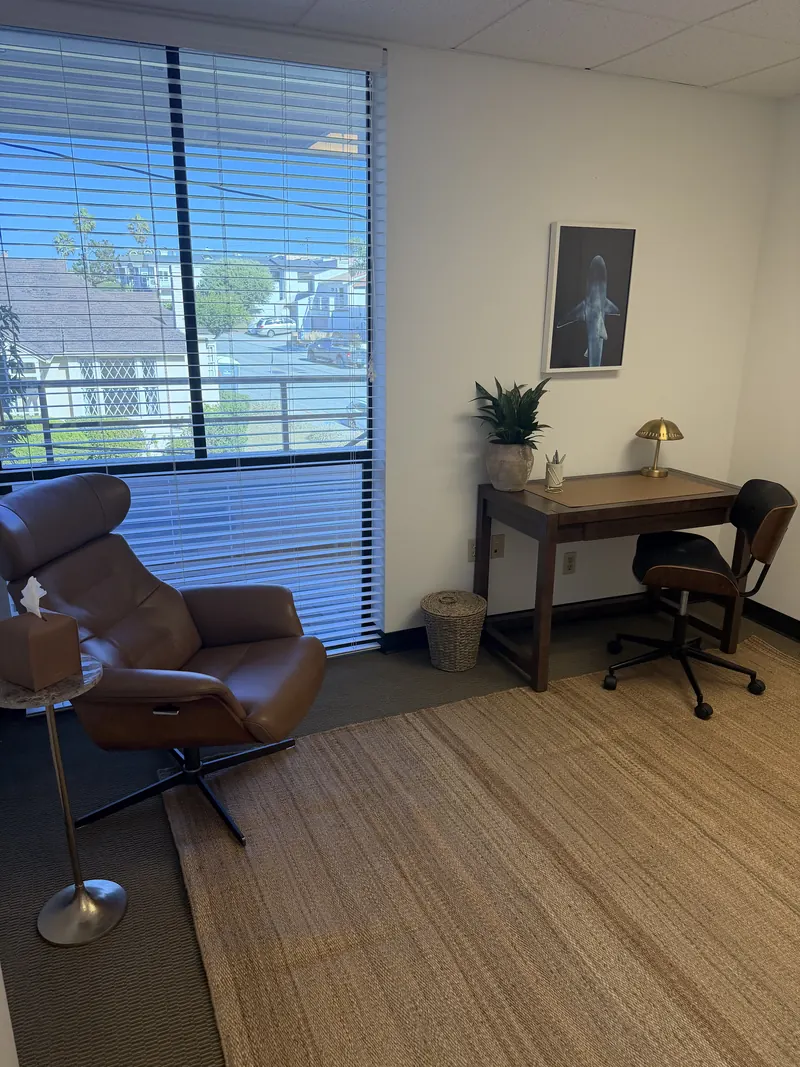
Our office is in the heart of the South Bay. Warm, private, and a world away from the clinical waiting room. For clients throughout California who can't make it in, we deliver the same uncompromising standard of care virtually.
2200 Pacific Coast Hwy, Ste 308, Hermosa Beach · Telehealth statewide
How it works
Starting is simple.
Book a free consultation
A confidential 15-minute call to understand what you need.
Get matched
We pair you with the right clinician for your goals.
Begin care
Start in person or online, at a pace that feels right.
Questions
Frequently asked
Is depression treatable?
Yes. Depression is one of the most researched conditions in mental health, and therapy, medication, or a combination help most people improve. How quickly depends on the person and how long the depression has been present, and we talk honestly about what is realistic from the start.
How do I find a depression therapist in Hermosa Beach, Redondo Beach, or Manhattan Beach?
Look for a licensed clinician who uses evidence-based approaches such as CBT or behavioral activation, who can explain how they would work with your situation, and who can coordinate with a psychiatrist if medication becomes part of the plan. Our office is on Pacific Coast Highway in Hermosa Beach, a short drive from Redondo Beach, Manhattan Beach, and Torrance, and we also see clients by video anywhere in California.
What is the best therapy for depression?
Cognitive behavioral therapy (CBT) and behavioral activation have some of the strongest evidence, and a large 2016 trial found behavioral activation as effective as CBT. Other approaches help when depression is tied to trauma, grief, or a relationship. We match the approach to what is driving your depression rather than using one method for everyone.
Do I need medication for depression?
Not always. Many people do well with therapy alone. When depression is severe, long-lasting, or has not improved with therapy, medication can help, and research shows therapy plus medication often works better than medication alone. Whether to start medication is always a decision you make with a prescriber.
How long does depression therapy take?
It varies. Some people notice changes within the first couple of months of weekly sessions. Depression that has been present for years, or that comes with anxiety or trauma, usually takes longer. Most people start weekly and space sessions out as things improve.
Do you treat depression in teens?
Yes. We work with teens and their families across the Beach Cities. Teen depression often looks like irritability, withdrawal, or slipping grades rather than sadness. Parents are involved in a way that respects the teen's privacy, and our teen therapy page explains how that works.
How is high-functioning depression different?
Some people keep working, parenting, and showing up while feeling persistently low, flat, or joyless underneath. It is still depression, and it is still worth treating, even when life looks fine from the outside.
Can I do depression therapy online?
Yes. We see clients in person at our Hermosa Beach office and by secure video anywhere in California. Video sessions can make it easier to keep going on the days when getting out the door feels hardest.
When you're ready, a conversation is the place to begin.
Book a complimentary 15-minute consultation, confidential, and without obligation.
Book a free consultation